What category does this threshold fall in
Quick answer
Enter three thresholds you have already copied from an audiogram and this returns the pure tone average of 500, 1000 and 2000 hertz, plus what that average is called on the United States clinical scale and on the World Health Organization 2021 grades. It cannot measure your hearing and it is not a hearing test.
Threshold to category
These are the three frequencies a pure tone average uses. Read them off the audiogram you already have. If you do not have one, this tool has nothing to work from and the answer is a hearing evaluation.
Enter values above to see the answer.
Equipment this answer points to

EarCentric EasyCharge
$159.00FDA regulated OTC hearing aid
Published specsA rechargeable pair sold with a desktop charging station, from a brand that has been in the direct to consumer hearing market since before the OTC rule.
Best for: A first pair for someone who wants a charging dock rather than handling batteries.
Check price on Amazon
JVC Self-Fitting OTC Hearing Aids, entry model
$199.95FDA regulated OTC hearing aid
JVC entry self-fitting device, explicitly labeled for mild to moderate hearing loss and built on an FDA cleared self-fitting process.
Best for: The $200 shopper who wants a mainstream brand and a real self-fitting procedure rather than a volume knob.
Check price on Amazon
Ceretone Horizon
$226.99FDA regulated OTC hearing aid
Published specsA dual microphone receiver in canal device at the bottom of the mid range, a form usually found several hundred dollars higher.
Best for: A buyer who wants the receiver in canal form without the premium price.
Check price on Amazon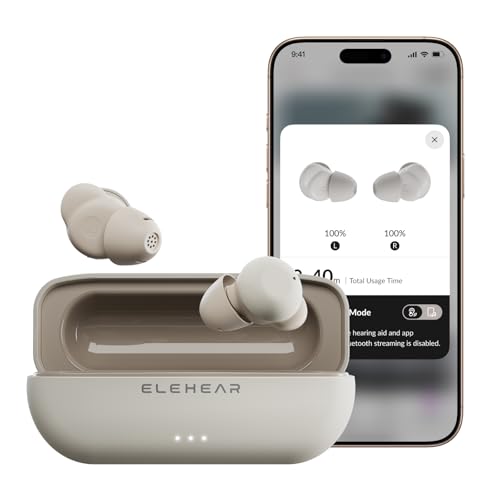
ELEHEAR Delight
$299.00FDA regulated OTC hearing aid
Published specsELEHEAR entry model at $299, keeping Bluetooth in the specification.
Best for: Someone who wants a branded OTC device at the bottom of the mid range.
Check price on AmazonCommon questions
- Can this tool test my hearing?
- No, and nothing on the internet can. A hearing threshold is produced by an audiometric test using calibrated equipment in a controlled acoustic environment, administered by a licensed professional. This tool takes numbers you have already copied from such a test and tells you what they are called on two published scales. That is a lookup, not a measurement.
- Why does it use only three frequencies?
- Because the severity categories are conventionally applied to a pure tone average of 500, 1000 and 2000 hertz, which is the region most of the information in speech occupies. Applying a category to a single high frequency threshold instead is a common way to reach an answer that sounds far worse than the audiogram supports, since high frequencies are usually the poorest on an age related chart.
- Why do the two scales give different answers?
- They were written for different purposes. The World Health Organization grades are designed for population reporting and put the boundary of unimpaired hearing at 20 dB HL. The clinical convention used in routine United States practice treats up to 25 dB HL as normal in adults. Both appear here because quoting one without naming it is a genuine source of confusion.
- Does the result tell me whether I need a hearing aid?
- No. That decision is made from the shape of a complete audiogram, from whether the two ears differ, and above all from where you actually have difficulty, not from one averaged number. An audiologist weighs all of that. A category is a label for a range of thresholds, not a recommendation about a device.
- What if my two ears give different results?
- Run each ear separately, and then take the difference seriously. A marked asymmetry between the ears is investigated rather than amplified, and it is one of the standard reasons to see a clinician promptly. Over the counter hearing aids are not intended for hearing loss that affects one ear substantially more than the other.
Get the complete hearing gear list
Every item in the starter, everyday and full setups, with running totals, in one printable list. It opens with a hearing evaluation, because that is genuinely the first step. No charge.
One list, no sequence of daily emails, and you can leave at any time.