The best over the counter hearing aids for seniors
Quick answer
For most older adults, the best OTC hearing aid is the Jabra Enhance Select 300 at $1,650.00, because it comes with remote audiology support already included rather than requiring a self-fitting app alone. Someone who wants to try amplification at the lowest possible cost first should start with the MDHearing NEO at $129.00 instead.
Age related hearing change, called presbycusis, is common enough that hearing difficulty is one of the most reported complaints in later life, and the FDA's OTC rule was written with exactly this reader in mind: adults 18 and over with perceived mild to moderate hearing loss, no exam required. What changes for an older buyer is not the regulation, it is which features actually matter day to day. Handling small zinc-air batteries, reading a phone app's fitting screen, and inserting a very small in-the-canal device all get harder with reduced dexterity or eyesight, and a device that looks impressive on a spec sheet can be the wrong choice if nobody in the house can actually manage it.
The five picks below weigh ease of handling and available support as heavily as price, organized into Beginner, Intermediate and Expert tiers. If cost of ownership or the OTC-versus-prescription decision is the open question, see hearing aid fitting cost and OTC vs prescription hearing aids before choosing a tier.
The picks
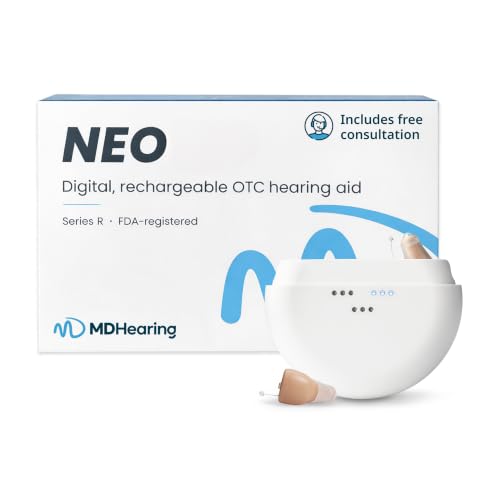
MDHearing NEO
$129.00FDA regulated OTC hearing aid
The least expensive device in this catalog, from MDHearingAid, a company with a long history in direct to consumer hearing aids and real phone support behind every purchase.
Best for: Finding out whether amplification helps at all, at the lowest possible cost, from a company you can actually call.
Check price on Amazon
EarCentric EasyCharge
$159.00FDA regulated OTC hearing aid
Published specsA rechargeable pair sold with a desktop charging station, from a brand that has been in the direct to consumer hearing market since before the OTC rule.
Best for: Someone who wants to drop the devices in a dock at night rather than handle tiny zinc-air batteries, which is often the single biggest barrier to daily use for an older wearer.
Check price on Amazon
MDHearing VOLT MAX 2
$597.00FDA regulated OTC hearing aid
Published specsA self-fitting behind the ear device from one of the longest established direct to consumer hearing aid companies in the United States, predating the OTC rule itself.
Best for: A buyer who wants a behind the ear device, which is generally easier to handle than an in-the-canal one, from an established American brand with phone support.
Check price on Amazon
Audien Atom X
$389.00FDA regulated OTC hearing aid
Audien sells direct at the low end of the branded OTC market, and the Atom X is its touchscreen controlled model rather than one that depends on a phone app.
Best for: Someone who wants on-device controls rather than a smartphone app, which matters if the wearer or their household is less comfortable with a phone-based fitting process.
Check price on Amazon
Jabra Enhance Select 300
$1,650.00FDA regulated OTC hearing aid
Published specsA receiver in ear rechargeable device sold with remote audiology support bundled into the price, so the fitting is done with a professional rather than through an app alone.
Best for: Someone who wants professional fine tuning without an in-person visit, and has budgeted for a four figure device to get it.
Check price on AmazonHow the tiers compare
Only the $1,650.00 Expert pick includes remote audiology support; the other four are self-fitting or on-device.
| Model | Tier | Price | Handling |
|---|---|---|---|
| MDHearing NEO | Beginner | $129.00 | Basic, no app |
| EarCentric EasyCharge | Beginner | $159.00 | Rechargeable, desktop dock |
| MDHearing VOLT MAX 2 | Intermediate | $597.00 | Self-fitting, rechargeable BTE |
| Audien Atom X | Intermediate | $389.00 | On-device touchscreen |
| Jabra Enhance Select 300 | Expert | $1,650.00 | Remote audiology support |
Buying tips
Rechargeable devices remove one entire task from the daily routine: nobody has to grip a battery the size of a shirt button and get it into a tiny door with the correct orientation. If handling is a concern for the wearer or for a family member helping out, weight that feature above almost anything else on a spec sheet, including price.
The Expert tier here is not the right start for everyone. Someone who is comfortable running a self-fitting app, or a family member managing a fixed budget, is usually better served starting at Beginner or Intermediate and stepping up only if the person keeps wearing the device and wants professional fine tuning. A $1,650 purchase made before that is confirmed is a common way an unused hearing aid ends up in a drawer.
Whatever tier is chosen, OTC hearing aids remain limited to adults with perceived mild to moderate hearing loss. Severe or profound loss, hearing loss confined to one ear, and hearing loss in anyone under 18 are all prescription-only routes fitted by a licensed audiologist, and no device on this page is the right answer to any of those situations.
How we chose
We compared manufacturer published specifications, the FDA device classification each product is sold under, and the recurring themes in verified owner reviews. We do not test hearing devices in person and we never claim to, because a hearing device is fitted to one person's ears and a reviewer's experience of one would tell you nothing about yours.
What we exclude, and why it is most of the category. Amazon results for "hearing aids" are dominated by unbranded amplifiers listed as over the counter hearing aids. A personal sound amplification product is not an FDA regulated hearing aid, and the FDA states plainly that it is not intended to compensate for hearing loss. Products with no identifiable manufacturer, products whose stated brand and title disagree, and products quoting a gain figure as though it were a published specification are left out. Honest personal amplifiers are carried in their own separate category and are labelled as such on every card.
We make no claim about how much any device will improve anyone's hearing. That is an outcome about a person, not a property of a product, and nobody selling one can tell you it either.
Common questions
- Is it safe for an older adult to self-fit an OTC hearing aid?
- The FDA cleared self-fitting devices for the fitting procedure itself, so yes, within the category's intended use of perceived mild to moderate hearing loss in adults 18 and over. What varies by person is comfort managing an app-based fitting screen, which is why the touchscreen and bundled-support picks above exist as alternatives for someone who would rather not use a phone app.
- What if the hearing loss is in one ear only or came on suddenly?
- Neither situation is appropriate for any device on this page, at any age. Asymmetric hearing loss is investigated rather than amplified, and sudden hearing loss is treated as urgent, with treatment usually attempted within a matter of days rather than weeks. Both call for a doctor and a proper evaluation, not an over the counter purchase, and delaying that call to try a device first can cost real time in the sudden loss case specifically.
- Are rechargeable models actually easier to manage than battery models?
- For most people, yes. A rechargeable device removes the task of gripping a small zinc-air battery and seating it correctly in a battery door, replacing that entire routine with placing the device on a charging dock at bedtime and picking it back up in the morning. The EarCentric EasyCharge above is built specifically around that dock-based routine, with a desktop charging station included in the price rather than sold separately.
- Can a family member set up a self-fitting OTC hearing aid for someone else?
- Nothing in the FDA rule prevents a family member from helping with the self-fitting process, and in practice this is common. The bundled-support Expert tier device exists for households that would rather have a professional involved in fine tuning instead of relying on a family member or the wearer alone.
- When does an older adult need a prescription device instead of an OTC one?
- Any degree of hearing loss beyond perceived mild to moderate, hearing loss confined to one ear, and any of the red flag symptoms above all call for a prescription hearing aid fitted by a licensed audiologist rather than an OTC device. A hearing evaluation, not an app-based check, is what determines which category actually applies.
Get the complete hearing gear list
Every item in the starter, everyday and full setups, with running totals, in one printable list. It opens with a hearing evaluation, because that is genuinely the first step. No charge.
One list, no sequence of daily emails, and you can leave at any time.
Last updated 2026-09-17.